

There is still a bit more than one day left for "very early birds" offer for EKON 27 conference in Germany, and meet us for 3 sessions (including a half-day training/introduction to mORMot 2)!
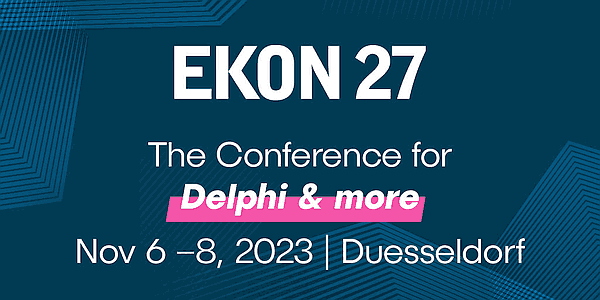
Join us the 6-8th of November in Düsseldorf!
2023-09-06
2023-09-06.
There is still a bit more than one day left for "very early birds" offer for EKON 27 conference in Germany, and meet us for 3 sessions (including a half-day training/introduction to mORMot 2)!
Join us the 6-8th of November in Düsseldorf!
2023-08-24
2023-08-24. Open Source › mORMot Framework

We are pleased to announce the release of mORMot 2.1.
The download link is available on github.

The mORMot family is growing up. 
2023-07-20
2023-07-20. Open Source › mORMot Framework
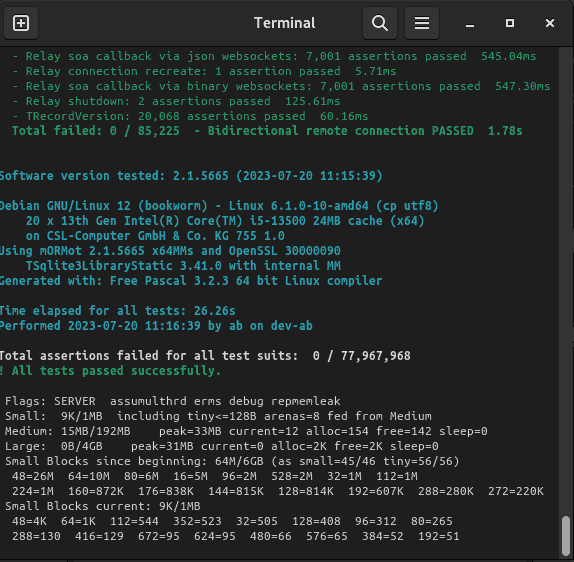
Since its earliest days, our mORMot framework did offer extensive regression tests. In fact, it is fully test-driven, and almost 78 million individual tests are performed to cover all its abilities:
We just integrated those tests to the TranquilIT build farm, and its great LUTI tool. So we have now continuous integration tests over several versions of Windows, Linux, and even Mac!
LUTI is the best mORMot's friends these days.
2023-05-05
2023-05-05. Open Source › mORMot Framework

DNS and LDAP are the two protocols on which the Internet and the Intranet are built.
Most of the time, you don't have to care about them. But sometimes, you need to access them directly, especially in a corporate environment.

We just introduced in our Open Source mORMot 2 framework two client units to access DNS and LDAP/CLDAP servers.
You can resolve IP addresses and services using DNS, and ask for information about your IT infrastructure using LDAP.
2023-04-19
2023-04-19. Open Source › mORMot Framework
For most projects, we want to be able to pass some custom values when starting it.
The command line is then used to add this additional information.
We have ParamStr and ParamCount global functions, enough to retrieve the information. You may also use FindCmdLineSwitch for something more easy to work with.
The Lazarus RTL offers some additional methods like hasOption or getOptionValue or checkOptions in its TCustomApplication class. Their are better, but not so easy to use, and not available on Delphi.
We just committed a new command line parser to our Open Source mORMot 2 framework, which works on both Delphi and FPC, follows both Windows and POSIX/Linux conventions, and has much more features (like automated generation of the help message), in an innovative and easy workflow.
2023-01-10
2023-01-10. Open Source › mORMot Framework

The mORMot 2 framework is about to be released as its first 2.0 stable version.

The framework feature set should now be considered as sealed for this release.
There is no issue reported still open at github or in the forum.
Please test it, and give here some feedback to fix any problem before the actual release!
We enter a framework code-freeze phase until then.
2022-12-28
2022-12-28. Open Source › mORMot Framework

This is perhaps the last new feature of mORMot 2 before its first stable release: a very efficient custom URI routing for our HTTP/HTTPS servers.

At ORM and SOA level, there is by-convention routing of the URI, depending on the ORM table, SOA interface and method, and TOrmModel.Root value. Even for our MVC web part, we rely on a /root/ URI prefix, which may not be always needed.
Relying on convention is perfect between mORMot clients and servers, but in some cases, it may be handy to have something smoother, e.g. to publish a truly REST scheme.
We introduced two routing abilities to mORMot 2, with amazing performance (6-12 million parsings per CPU core), via a new THttpServerGeneric.Route property:
/root/interface.method layout, or to a MVC web page;Article edited on 28th December:
Fixed performance numbers (much higher than reported), and introduced latest source changes.
2022-11-26
2022-11-26. Pascal Programming

A recent poll on the Lazarus/FPC forum highlighted a fact: pascal coders are older than most coders. Usually, at our age, we should be managers, not developers. But we like coding in pascal. It is still fun after decades!
But does it mean that you should not use pascal for any new project? Are the language/compilers/libraries outdated?
In the company I currently work for, we have young coders, just out-of-school or still-in-school, which joined the team and write great code!

And a recent thread in this very same forum was about comparing languages to implement a REST server, in C#, Go, Scala, TypeScript, Elixir and Rust.
Several pascal versions are about to be contributed, one in which mORMot shines.
« previous entries - page 4 of 53 - next entries »


