
We have uploaded an updatetd compiled version of our Open Source SynProject tool in SynProject.zip. Synopse SynProject is an open source application for code source versioning and automated documentation of software projects. Licensed under a GPL license. Main feature is a new (better-looking?) […]
2013-03-23
Download latest version of sqlite3.dll for Windows 64 bit
2013-03-23. Open Source › mORMot Framework
Update: We now build the amalgamation file with mingw and release the latest version of SQLite3, from this direct SQLite3-64.7z link, as soon as it is published on the SQLite3 site. Up to now, there is no official Win64 version of the SQlite3 library released in http://sqlite.org.. It is in fact […]
2013-03-13
x64 optimized asm of FillChar() and Move() for Win64
2013-03-13. Pascal Programming
We have included x64 optimized asm of FillChar() and Move() for Win64 - for corresponding compiler targets, i.e. Delphi XE2 and XE3. It will handle properly cache prefetch and appropriate SSE2 move instructions. The System.pas unit of Delphi RTL will be patched at startup, unless the NOX64PATCHRTL […]
2013-03-07
64 bit compatibility of mORMot units
2013-03-07. Open Source › mORMot Framework
I'm happy to announce that mORMot units are now compiling and working great in 64
bit mode, under Windows.
Need a Delphi XE2/XE3 compiler, of course!

ORM and services are now available in Win64, on both client and
server sides.
Low-level x64 assembler stubs have been created, tested and
optimized.
UI part is also available... that is grid display, reporting (with pdf
export and display anti-aliasing), ribbon auto-generation,
SynTaskDialog, i18n... the main SynFile demo just works
great!
Overall impression is very positive, and speed is comparable to 32 bit version (only 10-15% slower).
Speed decrease seems to be mostly due to doubled pointer size, and some less
optimized part of the official Delphi RTL.
But since mORMot core uses its own set of functions (e.g. for
JSON serialization, RTTI support or interface calls or stubbing), we were able
to release the whole 64 bit power of your hardware.
Delphi 64 bit compiler sounds stable and efficient. Even when working at low
level, with assembler stubs.
Generated code sounds more optimized than the one emitted by
FreePascalCompiler - and RTL is very close to 32 bit mode.
Overall, VCL conversion worked as easily than a simple re-build.
Embarcadero's people did a great job for VCL Win64 support, here!
2013-02-25
Using external MinGW/VisualC++ sqlite3.dll - including benchmark
2013-02-25. Open Source › mORMot Framework
With upcoming revision 1.18 of the framework, our
SynSQlite3.pas unit is able to access the SQLite3 engine
in two ways:
- Either statically linked within the project executable;
- Or from an external
sqlite3.dlllibrary file.

The SQLite3 APIs and constants are defined in
SynSQlite3.pas, and accessible via a TSQLite3Library
class definition. It defines a global sqlite3 variable as
such:
var
  sqlite3: TSQLite3Library;
To use the SQLite3 engine, an instance of
TSQLite3Library class shall be assigned to this global variable.
Then all mORMot's calls will be made through it, calling e.g.
sqlite3.open() instead of sqlite3_open().
There are two implementation classes:
| Class | Unit | Purpose |
TSQLite3LibraryStatic |
SynSQLite3Static.pas |
Statically linked engine (.obj within the
.exe) |
TSQLite3LibraryDynamic |
SynSQLite3.pas |
Instantiate an external sqlite3.dll instance |
Referring to SynSQLite3Static.pas in the uses
clause of your project is enough to link the .obj engine into your
executable.
Warning - breaking change: before version 1.18 of the framework,
link of static .obj was forced - so you must add a reference to
SynSQLite3Static in your project uses clause to work
as expected.
In order to use an external sqlite3.dll library, you have to
set the global sqlite3 variable as such:
 FreeAndNil(sqlite3); // release any previous instance (e.g. static)
 sqlite3 := TSQLite3LibraryDynamic.Create;
Of course, FreeAndNil(sqlite3) is not mandatory, and should be
necessary only to avoid any memory leak if another SQLite3 engine
instance was allocated (may be the case if SynSQLite3Static is
referred somewhere in your project's units).
Here are some benchmarks, compiled with Delphi XE3, run in a 32 bit
project, using either the static bcc-compiled engine, or an external
sqlite3.dll, compiled via
MinGW or Microsoft Visual C++.
2013-02-17
Interface-based service sample: remote SQL access
2013-02-17. Open Source › mORMot Framework

You will find in the SQLite3\Sample\16 - Execute SQL via
services folder of mORMot source code a Client-Server sample
able to access any external database via JSON and HTTP.
It is a good demonstration of how to use an interface-based service between
a client and a server.
It will also show how our SynDB classes have a quite abstract
design, and are easy to work with, whatever database provider you need to
use.
The corresponding service contract has been defined:
  TRemoteSQLEngine = (rseOleDB, rseODBC, rseOracle, rseSQlite3, rseJet, rseMSSQL);

  IRemoteSQL = interface(IInvokable)
    ['{9A60C8ED-CEB2-4E09-87D4-4A16F496E5FE}']
    procedure Connect(aEngine: TRemoteSQLEngine; const aServerName, aDatabaseName,
      aUserID, aPassWord: RawUTF8);
    function GetTableNames: TRawUTF8DynArray;
    function Execute(const aSQL: RawUTF8; aExpectResults, aExpanded: Boolean): RawJSON;
  end;
Purpose of this service is:
- To Connect() to external databases, given the parameters of a
standard TSQLDBConnectionProperties. Create() constructor;
- Retrieve all table names of this external database as a list;
- Execute any SQL statement, returning the content as JSON array, ready to be
consumed by AJAX applications (if aExpanded is true),
or a Delphi client (e.g. via a TSQLTableJSON and the
mORMotUI unit).
Of course, this service will be define as sicClientDriven mode,
that is, the framework will be able to manage a client-driven
TSQLDBProperties instance life time.
Benefit of this service is that no database connection is required on the
client side: a regular HTTP connection is enough.
No need to install nor configure any database provider, and full SQL access to
the remote databases.
Due to our optimized JSON serialization, it will probably be faster to work with such plain HTTP / JSON services, instead of a database connection through a VPN. In fact, database connections are made to work on a local network, and do not like high-latency connections, which are typical on the Internet.
2013-02-12
Introducing ZEOS, UniDAC, NexusDB, BDE, any TDataset to SynDB and mORMot's ORM
2013-02-12. Open Source › mORMot Framework
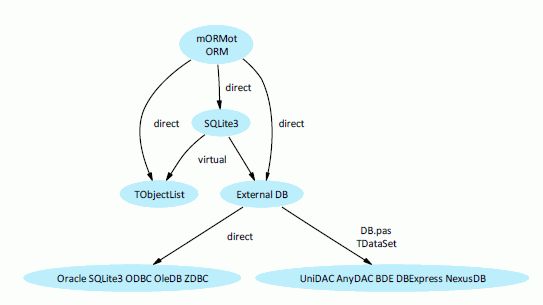
Up to now, our SynDB database classes were handling
ODBC, OleDB providers and direct Oracle or
SQLite3 connection.
We have added a DB.pas based layer, ready to be used with
UniDAC, NexusDB, or the BDE.
Any other TDataset based component is ready to be interfaced,
including UIB, AnyDAC or DBExpress.
The ZEOS library (in its latest 7.0.3
stable version, which works from Delphi 7 up to XE3) has also been
interfaced, but without the TDataset/DB.pas layer:
our SynDBZEOS.pas unit calls the ZDBC layer, which is not
tied to DB.pas nor its RAD components, and is therefore
faster. By the way, it will work also with the Starter edition of
Delphi (which does not include the DB components) - just like the other
"regular" SynDB classes.

This is a work in progress, any testing and feedback is welcome!
We had to circumvent some particularities of the libraries, but I guess we have
something interesting.
A dedicated "SynDBDataset" sub-folder has been created in the repository, to contain all
SynDBDataset.pas-based database providers.
SynDBNexusDB.pas unit has been moved within this sub-folder,
as SynDBUniDAC.pas + SynDBBDE.pas units have
been added.
SynDBZeos.pas has a direct access to the ZDBC layer, so
is not part of the "SynDBDataset" sub-folder.
Here is some benchmark, mainly about Oracle and
SQlite3 database access.
Of course, our direct SynDBOracle / SynDBSQLite3
layers are the fastest around, and we can see that ZDBC layer is sometimes more
efficient than the TDataset components.
2013-02-03
Log to the console
2013-02-03. Open Source › mORMot Framework
Our framework features an integrated logging class, ready to be enabled for support and statistics.
For debugging purposes, it could be very handy to output the logging content
to a console window.
It enables interactive debugging of a Client-Server process, for instance: you
can interact with the Client, then look in real time at the server console
window, and inspect which requests are processed, without the need to open the
log file.

Depending on the events, colors will be used to write the corresponding information. Errors will be displayed as light red, for instance.
« previous entries - page 28 of 53 - next entries »


