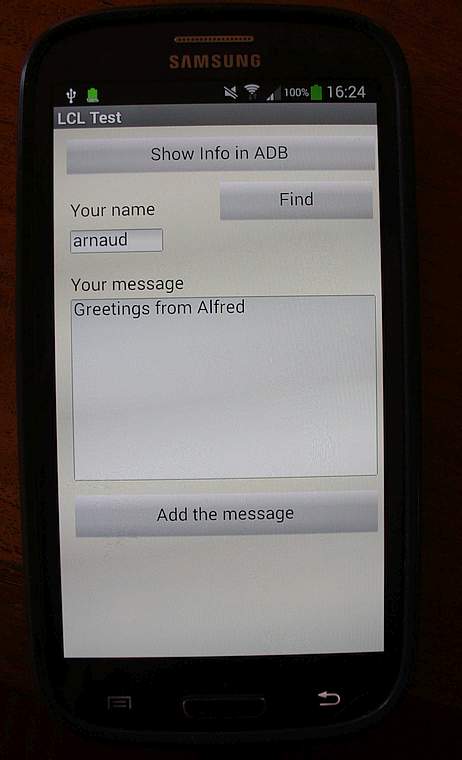
I just received a mail from Alfred (aka Alf in the source code), which did a lot of work to let our little mORMot compiles and run with FPC, especially under Linux, and also with an ARM processor. Hello Arnaud, A nice surprise ... Sample 2 native on Android !!!! See picture. Works 100% !!! […]
2015-02-21
SynCrypto: SSE4 x64 optimized asm for SHA-256
2015-02-21. Open Source › Open Source libraries
We have just included some optimized x64 assembler to our Open
Source SynCrypto.pas unit
so that SHA-256 hashing will perform at best speed.
It is an adaptation from
tuned Intel's assembly macros, which makes use of the SSE4 instruction set,
if available.

2015-02-16
Benchmarking JsonDataObjects JSON parser
2015-02-16. Open Source
There is a
new player in town.
Since it has been written by Andreas Hausladen, the maintainer of the
great Delphi IDE fix packs,
this new JSON library is very promising.

And in fact, it is fast, and sounds pretty great!
Here are some numbers, compared with SuperObject, standard
DBXJson, dwsJSON, QDAC and mORMot.
Please refer to previous
benchmark articles about those libraries. We will now focus on
JsonDataObjects.
2015-02-01
Benchmarking QDAC3 JSON parser
2015-02-01. Open Source › mORMot Framework
Do you know QDAC3 ?
This is an open source project, from China (with Chinese comments and exception
errors messages, but the methods and variables are in English).
It is cross-platform, and told to be very fast about JSON process.

You can download this Open Source project code from http://sourceforge.net/projects/qdac3
And their blog - in Chinese - is at http://blog.qdac.cc/
So I included QDAC3 in
our "25 - JSON performance" sample.
Numbers are talking, now.
2015-01-15
AES-NI enabled for SynCrypto
2015-01-15. Open Source
Today, we committed a new patch to enable AES-NI hardware acceleration to our SynCrypto.pas unit. Intel® AES-NI is a new encryption instruction set that improves on the Advanced Encryption Standard (AES) algorithm and accelerates the encryption of data on newer processors. Of course, all this is […]
2015-01-10
mORMot under Linux thanks to FPC
2015-01-10. Open Source › mORMot Framework
You can use the FreePascal Compiler (FPC) to compile the mORMot framework source code, targetting Windows and Linux.

Linux is a premium target for cheap and efficient server Hosting. Since mORMot has no dependency, installing a new mORMot server is as easy as copying its executable on a blank Linux host, then run it. No need to install any framework nor runtime. You could even use diverse operating systems (several Linux or Windows Server versions) in your mORMot servers farm, with minimal system requirements, and updates.
We will now see how to write your software with Linux-compiling in mind, and also give some notes about how to install a Linux Virtual Machine with Lazarus on your Windows computer, compiling both FPC and Lazarus from their SVN latest sources!
2014-12-31
2015: the future of mORMot is BigData
2014-12-31. Open Source › mORMot Framework
How would be 2015 like for our little rodents?
Due to popular request of several users of mORMot, we identified and
designed some feature requests dedicated to BigData process.

In fact, your data is the new value, especially if you propose
SaaS (Software As A Service)
hosting to your customers, with a farm of mORMot
servers.
Recent Linux support for mORMot servers, together with the
high performance and installation ease of our executable, open the gate to
cheap cloud-based hosting.
As a consequence, a lot of information would certainly be gathered by
your mORMot servers, and a single monolithic database
is not an option any more.
For mORMot solutions hosted in cloud, a lot of data may be generated. The default SQLite3 storage engine may be less convenient, once it reaches some GB of file content. Backup becomes to be slow and inefficient, and hosting this oldest data in the main DB, probably stored on an expensive SSD, may be a lost of resource. Vertical scaling is limited by hardware and price factors.
This is were data sharding comes into scene.
Note that sharding is not replication/backup, nor clustering, nor just
spreading. We are speaking about application-level data splitting, to ease
maintenance and horizontal scalability of mORMot servers.
Data sharding could already be implemented with mORMot servers,
thanks to TSQLRestStorage:
- Using
TSQLRestStorageExternal: any table may have its own external SQL database engine, may be in its separated DB server; - Using
TSQLRestStorageMongoDB: any table may be stored on a MongoDB cluster, with its own sharding abilities; - Using
TSQLRestStorageRemote: each table may have its own remote ORM/REST server.
But when data stored in a single table tends to grow without limit, this
feature is not enough.
Let's see how the close future of mORMot looks like.
2014-11-28
ODM magic: complex queries over NoSQL / MongoDB
2014-11-28. Open Source › mORMot Framework
You know that our mORMot is able to access directly any MongoDB database engine, allowing its ORM to become an ODM, and using NoSQL instead of SQL for the query languages.

But at mORMot level, you could share the same code between your
RDBMS and NoSQL databases.
The ORM/ODM is able to do all the conversions by itself!
Since we have just
improved this feature, it is time to enlighten its current status.
« previous entries - page 16 of 52 - next entries »