2014-05-02

mORMot on GitHub

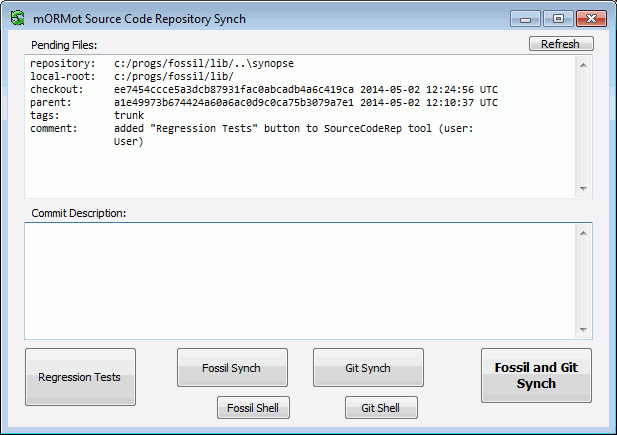
There was a long-standing request from customers, about putting all our source code repository to GitHub.

We like a lot our self-hosted Fossil repository, and will continue to use it as our main system, including issue tracking and wiki, for our official web site.

But we created a repository on GitHub, on https://github.com/synopse/mORMot

Continue reading

2014-04-28

Mustache Logic-less templates for Delphi - part 3

Mustache is a well-known logic-less template engine.
There is plenty of Open Source implementations around (including in JavaScript, which can be very convenient for AJAX applications on client side, for instance).
For mORMot, we created the first pure Delphi implementation of it, with a perfect integration with other bricks of the framework.

In last part of this series of blog articles, we will introduce the Mustache library included within mORMot source code tree.
You can download this documentation as one single pdf file.

Continue reading

Mustache Logic-less templates for Delphi - part 2

Mustache is a well-known logic-less template engine.
There is plenty of Open Source implementations around (including in JavaScript, which can be very convenient for AJAX applications on client side, for instance).
For mORMot, we created the first pure Delphi implementation of it, with a perfect integration with other bricks of the framework.

In this second part of this series of blog articles, we will introduce the Mustache syntax.
You can download this documentation as one single pdf file.

Continue reading

Mustache Logic-less templates for Delphi - part 1

Mustache is a well-known logic-less template engine.
There is plenty of Open Source implementations around (including in JavaScript, which can be very convenient for AJAX applications on client side, for instance).
For mORMot, we created the first pure Delphi implementation of it, with a perfect integration with other bricks of the framework.

In this first part of this series of blog articles, we will introduce the Mustache design.
You can download this documentation as one single pdf file.

Continue reading

2014-04-18

Introducing mORMot's architecture and design principles

We have just released a set of slides introducing  ORM, SOA, REST, JSON, MVC, MVVM, SOLID, Mocks/Stubs, Domain-Driven Design concepts with Delphi,  and showing some sample code using our Open Source mORMot framework. You can follow the public link on Google Drive! This is a great opportunity to  […]

Continue reading

2014-04-07

JavaScript support in mORMot via SpiderMonkey

As we already stated, we finished the first step of integration of the SpiderMonkey engine to our mORMot framework.
Version 1.8.5 of the library is already integrated, and latest official revision will be soon merged, thanks to mpv's great contribution.
It can be seen as stable, since it is already used on production site to serve more than 1,000,000 requests per day.

You can now easily uses JavaScript on both client and server side.
On server side, mORMot's implementation offers an unique concept, i.e. true multi-threading, which is IMHO a huge enhancement when compared to the regular node.js mono-threaded implementation, and its callback hell.
In fact, node.js official marketing states its non-blocking scheme is a plus. It allows to define a HTTP server in a few lines, but huge server applications need JavaScript experts not to sink into a state a disgrace.

Continue reading

2014-03-29

Enhanced and fixed late-binding of variants for Delphi XE2 and up

For several units of our framework, we allow late-binding of data values, using a variant and direct named access to properties:
- In SynCommons, we defined our TDocVariant custom variant type, able to store any JSON/BSON document-based content;
- In SynBigTable, we use the TSynTableVariantType custom variant type, as defined in SynCommons;
- In SynDB, we defined a TSQLDBRowVariantType, ready to access any column of a RDBMS data result set row;
- In mORMot, we allow access to TSQLTableRowVariantType column values.

It's a very convenient way of accessing result rows values. Code is still very readable, and safe at the same time.

For instance, we can write:

var V: variant;
 ...
  TDocVariant.New(V); // or slightly slower V := TDocVariant.New;
  V.name := 'John';
  V.year := 1972;
  // now V contains {"name":"john","year":1982}

This is just another implementation of KISS design in our framework.

Since Delphi XE2, some modifications were introduced to the official DispInvoke() RTL implementation:

  1. A new varUStrArg kind of parameter has been defined, which will allow to transmit UnicodeString property values;
  2. All text property values would be transmitted as BSTR / WideString / varOleStr variants to the invoked variant type;
  3. All textual property names were normalized to be in UPPERCASE.

Those modifications are worth considering...
And we may have discovered two regressions: one about speed, and the other about an unexpected logic bug...

Continue reading

2014-03-13

ORM mapping class fields to external table columns

When working with an ORM, you have mainly two possibilites:

  1. Start from scratch, i.e. write your classes and let the ORM creates all the database structure - it is also named "code-first";
  2. From an existing database, you define in your model how your classes map the existing database structure - this is "database-first".

We have just finalized ORM external table field mapping in mORMot, using e.g.
aModel.Props[aExternalClass].ExternalDB.MapField(..)
See this last commit.

So you can write e.g.

fProperties := TSQLDBSQLite3ConnectionProperties.Create(
  SQLITE_MEMORY_DATABASE_NAME,'','','');
VirtualTableExternalRegister(fExternalModel,
  TSQLRecordPeopleExt,fProperties,'PeopleExternal');
fExternalModel.Props[TSQLRecordPeopleExt].ExternalDB.
  MapField('ID','Key').
  MapField('YearOfDeath','YOD');

Then you use your TSQLRecordPeopleExt table as usual from Delphi code, with ID and YearOfDeath fields:

  • The "internal" TSQLRecord class will be stored within the PeopleExternal external table;
  • The "internal" TSQLRecord.ID field will be an external "Key: INTEGER" column;
  • The "internal" TSQLRecord.YearOfDeath field will be an external "YOD: BIGINT" column;
  • Other internal published properties will be mapped by default with the same name to external column.

Continue reading

- page 22 of 52 -