
Did you notice the new https://www.beginend.net web site, by Eric Grange? It is a blog feeds aggregator web site, dedicated to Delphi! It features: a maintained list of websites (including our very little blog); fast to load - thanks to good use of CDN; is not polluted by ads; nor breaking the links […]
2015-05-18
CQRS Persistence Service of any DDD object with mORMot
2015-05-18. Open Source › mORMot Framework
We introduced DDD concepts some time ago, in a series of articles in this blog. At that time, we proposed a simple way of using mORMot types to implement DDD in your applications. But all Domain Entitities being tied to the framework TSQLRecord class did appear as a limitation, breaking the […]
2015-05-14
Using TSynLog with a lot of threads? PYou should better upgrade your source
2015-05-14. Open Source › mORMot Framework
We identified and fixed today several issues which may affect applications creating a lot of threads (i.e. not using a thread pool). The symptom was an unexpected access violation, when you reach a multiple of 256 threads count. You should better upgrade to at least revision 1.18.1351 if your […]
2015-05-08
I do not like people shoot in my foot, do you?
2015-05-08. Pascal Programming
There was some discussion about the new
TStringHelper feature introduced in latest versions of
Delphi.
I was
told to be some kind of archaic guy, not able to see the benefit of
this.
Reducing opinions to a conservative/progressive approach - another famous 10
kinds of coders - is very reductive.
Of course, this was IMHO unfair and my point was that I have the feeling
that some decisions about the Delphi language and RTL are inadequate.
Some changes are welcome. I enjoy the introduction of generics - even if it is
was painful, and even buggy (do not use TList<T> with
managed record types in XE8!).
But some upcoming changes about the string policy - breaking
everything just because we want to align with mainstream C# or Java habits -
are just non sense to me.
I really think that Embarcadero deciders like to shoot their own foot.
Or - certainly worse - our own feet!

I will post here some part of the discussion...
So that we may be able to share our ideas.
2015-05-03
SOLID Design Principles
2015-05-03. Pascal Programming
I've just updated the documentation part about the SOLID Design
Principles.
The former blog article
(almost 4 years old!) sounds like a bit deprecated now...
This is why I would extract here an updated version of this material.
Ensure you checked the corresponding part of the mORMot documentation, which is the updated reference, and probably the easiest to read - including links to all the other documentation.
The acronym SOLID is derived from the following OOP principles (quoted from the corresponding Wikipedia article):
- Single responsibility principle: the notion that an object should have only a single responsibility;
- Open/closed principle: the notion that "software entities ... should be open for extension, but closed for modification";
- Liskov substitution principle: the notion that "objects in a program should be replaceable with instances of their subtypes without altering the correctness of that program” - also named as "design by contract";
- Interface segregation principle: the notion that "many client specific interfaces are better than one general purpose interface.";
- Dependency inversion principle: the notion that one should "Depend upon Abstractions. Do not depend upon concretions.". Dependency injection is one method of following this principle, which is also called Inversion Of Control (aka IoC).
If you have some programming skills, those principles are general statements you may already found out by yourself. If you start doing serious object-oriented coding, those principles are best-practice guidelines you would gain following.
They certainly help to fight the three main code weaknesses:
- Rigidity: Hard to change something because every change affects too many other parts of the system;
- Fragility: When you make a change, unexpected parts of the system break;
- Immobility: Hard to reuse in another application because it cannot be disentangled from the current application.
2015-04-20
Delphi is not a cross-compiler, but a set of cross-compilers
2015-04-20. Pascal Programming
It is worth saying again.
I'm not speaking this time about performance
issues, but about a common misunderstanding of what the latest version of
Delphi offers.
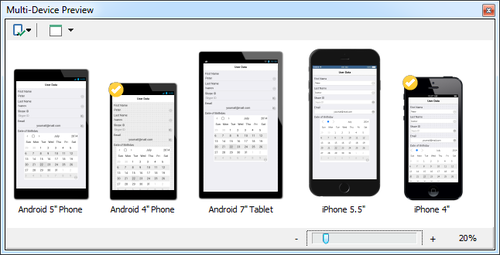
Since Delphi "NextGen"
compilers did break the memory model (introducing
ARC), and also reducing low-level types (e.g. RawByteString/AnsiString),
we can not say that Delphi is a single cross-compiler.
In practice, it has a set of cross-compilers.
2015-04-12
Why Transmitting Exceptions in SOA services is not a good idea
2015-04-12. Open Source › mORMot Framework
Usually, in Delphi application (like in most high-level languages), errors
are handled via exceptions. By default, any Exception
raised on the server side, within an interface-based service
method, will be intercepted, and transmitted as an error to the client side,
then a safe but somewhat obfuscated EInterfaceFactoryException
will be raised on the client side, containing additional information serialized
as JSON.

You may wonder why exceptions are not transmitted and raised directly on the client side, with our mORMot framework interface-based services, as if they were executed locally.
We will now detail some arguments, and patterns to be followed.
2015-04-06
Asynchronous Service - WebSockets, Callbacks and Publish-Subscribe
2015-04-06. Open Source › mORMot Framework

When publishing SOA services, most of them are defined as
stateless, in a typical query/answer pattern - see
Service-Oriented Architecture (SOA).
This fits exactly with the RESTful approach of Client-Server
services via interfaces, as proposed by the framework.
But it may happen that a client application (or service) needs to know the state of a given service. In a pure stateless implementation, it will have to query the server for any state change, i.e. for any pending notification - this is called polling.
Polling may take place for instance:
- When a time consuming work is to be processed on the server side. In this case, the client could not wait for it to be finished, without raising a timeout on the HTTP connection: as a workaround, the client may start the work, then ask for its progress status regularly using a timer and a dedicated method call;
- When an unpredictable event is to be notified from the server side. In this case, the client should ask regularly (using a timer, e.g. every second), for any pending event, then react on purpose.
It may therefore sounds preferred, and in some case necessary, to have the ability to let the server notify one or several clients without any prior query, nor having the requirement of a client-side timer:
- Polling may be pretty resource consuming on both client and server sides, and add some unwanted latency;
- If immediate notification is needed, some kind of "long polling" algorithm may take place, i.e. the server will wait for a long time before returning the notification state if no event did happen: in this case, a dedicated connection is required, in addition to the REST one;
- In an event-driven systems, a lot of messages are sent to the clients: a proper publish/subscribe mechanism is preferred, otherwise the complexity of polling methods may increase and become inefficient and unmaintainable;
- Explicit push notifications may be necessary, e.g. when a lot of potential events, associated with a complex set of parameters, are likely to be sent by the client.
Our mORMot framework is therefore able to easily implement
asynchronous callbacks over WebSockets,
defining the callbacks as interface parameters in service method
definitions - see
Available types for methods parameters.
« previous entries - page 15 of 53 - next entries »
