2014-02-25

TDocVariant custom variant type

With revision 1.18 of the framework, we just introduced two new custom types of variants:

  • TDocVariant kind of variant;
  • TBSONVariant kind of variant.

The second custom type (which handles MongoDB-specific extensions - like ObjectID or other specific types like dates or binary) will be presented later, when dealing with MongoDB support in mORMot, together with the BSON kind of content. BSON / MongoDB support is implemented in the SynMongoDB.pas unit.

We will now focus on TDocVariant itself, which is a generic container of JSON-like objects or arrays.
This custom variant type is implemented in SynCommons.pas unit, so is ready to be used everywhere in your code, even without any link to the mORMot ORM kernel, or MongoDB.

TDocVariant documents

TDocVariant implements a custom variant type which can be used to store any JSON/BSON document-based content, i.e. either:

  • Name/value pairs, for object-oriented documents;
  • An array of values (including nested documents), for array-oriented documents;
  • Any combination of the two, by nesting TDocVariant instances.

Here are the main features of this custom variant type:

  • DOM approach of any object or array documents;
  • Perfect storage for dynamic value-objects content, with a schema-less approach (as you may be used to in scripting languages like Python or JavaScript);
  • Allow nested documents, with no depth limitation but the available memory;
  • Assignment can be either per-value (default, safest but slower when containing a lot of nested data), or per-reference (immediate reference-counted assignment);
  • Very fast JSON serialization / un-serialization with support of MongoDB-like extended syntax;
  • Access to properties in code, via late-binding (including almost no speed penalty due to our VCL hack as already detailed);
  • Direct access to the internal variant names and values arrays from code, by trans-typing into a TDocVariantData record;
  • Instance life-time is managed by the compiler (like any other variant type), without the need to use interfaces or explicit try..finally blocks;
  • Optimized to use as little memory and CPU resource as possible (in contrast to most other libraries, it does not allocate one class instance per node, but rely on pre-allocated arrays);
  • Opened to extension of any content storage - for instance, it will perfectly integrate with BSON serialization and custom MongoDB types (ObjectID, RegEx...), to be used in conjunction with MongoDB servers;
  • Perfectly integrated with our Dynamic array wrapper and its JSON serialization as with the record serialization;
  • Designed to work with our mORMot ORM: any TSQLRecord instance containing such variant custom types as published properties will be recognized by the ORM core, and work as expected with any database back-end (storing the content as JSON in a TEXT column);
  • Designed to work with our mORMot SOA: any interface-based service is able to consume or publish such kind of content, as variant kind of parameters;
  • Fully integrated with the Delphi IDE: any variant instance will be displayed as JSON in the IDE debugger, making it very convenient to work with.

To create instances of such variant, you can use some easy-to-remember functions:

  • _Obj() _ObjFast() global functions to create a variant object document;
  • _Arr() _ArrFast() global functions to create a variant array document;
  • _Json() _JsonFast() _JsonFmt() _JsonFastFmt() global functions to create any variant object or array document from JSON, supplied either with standard or MongoDB-extended syntax.

Continue reading

2014-01-10

RESTful mORMot

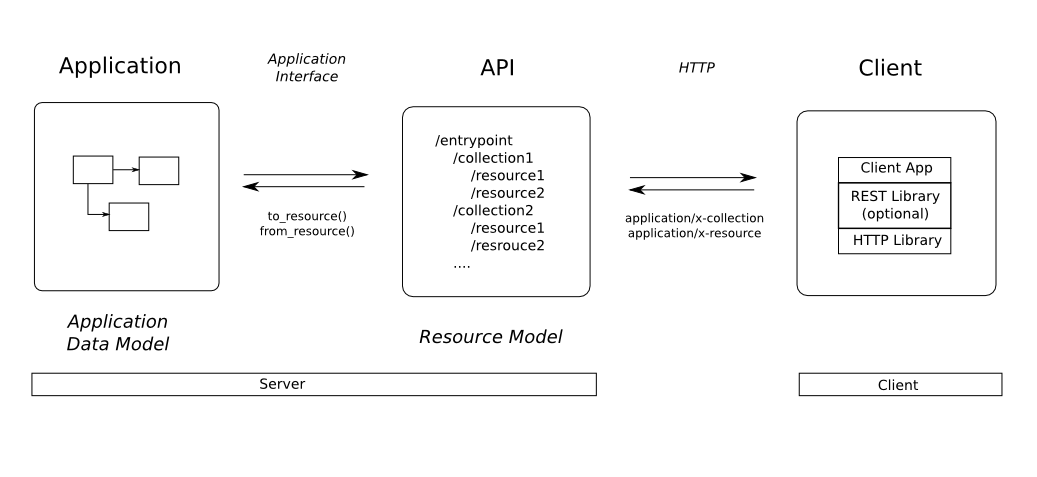
Our Synopse mORMot Framework was designed in accordance with Fielding's REST architectural style without using HTTP and without interacting with the World Wide Web.
Such Systems which follow REST principles are often referred to as "RESTful".

Optionally, the Framework is able to serve standard HTTP/1.1 pages over the Internet (by using the mORMotHttpClient / mORMotHttpServer units and the TSQLHttpServer and TSQLHttpClient classes), in an embedded low resource and fast HTTP server.

Continue reading

REpresentational State Transfer (REST)

Representational state transfer (REST) is a style of software architecture for distributed hypermedia systems such as the World Wide Web.
As such, it is not just a method for building "web services". The terms "representational state transfer" and "REST" were introduced in 2000 in the doctoral dissertation of Roy Fielding, one of the principal authors of the Hypertext Transfer Protocol (HTTP) specification, on which the whole Internet rely.


There are 5 basic fundamentals of web which are leveraged to create REST services:

  1. Everything is a Resource;
  2. Every Resource is Identified by a Unique Identifier;
  3. Use Simple and Uniform Interfaces;
  4. Communication is Done by Representation;
  5. Every Request is Stateless.

Continue reading

2014-01-07

Some enhancements to REST routing of interface-based services

We have just committed some enhancements to interface-based service process.

TSQLRestRoutingREST will now recognize several URI schemes, like new  root/Calculator/Add?n1=1&n2=2 alternative could be pretty convenient to be consumed from some REST clients.

Please find here a documentation update.

Continue reading

2014-01-05

AES encryption over HTTP

In addition to regular HTTPS flow encryption, which is not easy to setup due to the needed certificates, mORMot proposes a proprietary encryption scheme. It is based on SHA-256 and AES-256/CTR algorithms, so is known to be secure.

You do not need to setup anything on the server or the client configuration, just run the TSQLHttpClient and TSQLHttpServer classes with the corresponding parameters.

Continue reading

2014-01-04

Domain-Driven Design: part 4

Clean Uncoupled Domain-Oriented Architecture

One year ago, we already made a quick presentation of Domain-Driven Design, in the context of our mORMot framework.
After one year of real-world application of those patterns, it is now time to give more light to DDD.

Let's continue with part 4, which will define Domain-Driven Design as could be implemented with our Synopse mORMot framework

Continue reading

Domain-Driven Design: part 3

One year ago, we already made a quick presentation of Domain-Driven Design, in the context of our mORMot framework.
After one year of real-world application of those patterns, it is now time to give more light to DDD.

Let's continue with part 3, which will define Domain-Driven Design patterns and principles - this will be the main article of the whole serie!

Continue reading

Domain-Driven Design: part 2

One year ago, we already made a quick presentation of Domain-Driven Design, in the context of our mORMot framework.
After one year of real-world application of those patterns, it is now time to give more light to DDD.

Let's continue with part 2, which will define Domain-Driven Design high-level model principles.

Continue reading

- page 23 of 52 -