2014-01-10

REpresentational State Transfer (REST)

Representational state transfer (REST) is a style of software architecture for distributed hypermedia systems such as the World Wide Web.
As such, it is not just a method for building "web services". The terms "representational state transfer" and "REST" were introduced in 2000 in the doctoral dissertation of Roy Fielding, one of the principal authors of the Hypertext Transfer Protocol (HTTP) specification, on which the whole Internet rely.

 

There are 5 basic fundamentals of web which are leveraged to create REST services:

  1. Everything is a Resource;
  2. Every Resource is Identified by a Unique Identifier;
  3. Use Simple and Uniform Interfaces;
  4. Communication is Done by Representation;
  5. Every Request is Stateless.

Continue reading

2014-01-07

Some enhancements to REST routing of interface-based services

We have just committed some enhancements to interface-based service process.

TSQLRestRoutingREST will now recognize several URI schemes, like new  root/Calculator/Add?n1=1&n2=2 alternative could be pretty convenient to be consumed from some REST clients.

Please find here a documentation update.

Continue reading

2014-01-05

AES encryption over HTTP

In addition to regular HTTPS flow encryption, which is not easy to setup due to the needed certificates, mORMot proposes a proprietary encryption scheme. It is based on SHA-256 and AES-256/CTR algorithms, so is known to be secure.

You do not need to setup anything on the server or the client configuration, just run the TSQLHttpClient and TSQLHttpServer classes with the corresponding parameters.

Continue reading

2014-01-04

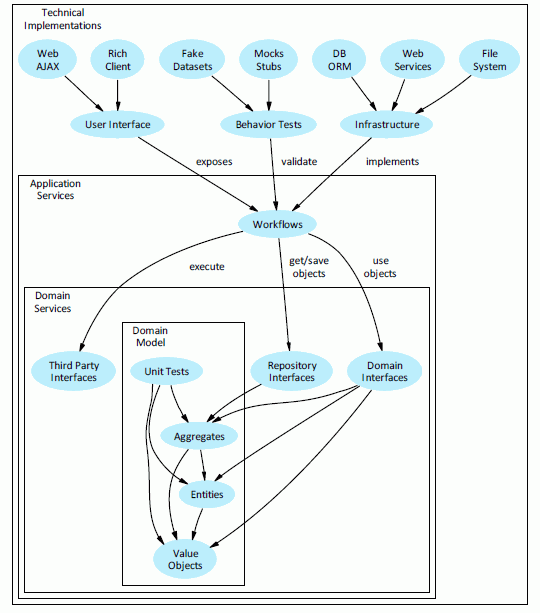
Domain-Driven Design: part 4

Clean Uncoupled Domain-Oriented Architecture

One year ago, we already made a quick presentation of Domain-Driven Design, in the context of our mORMot framework.
After one year of real-world application of those patterns, it is now time to give more light to DDD.

Let's continue with part 4, which will define Domain-Driven Design as could be implemented with our Synopse mORMot framework

Continue reading

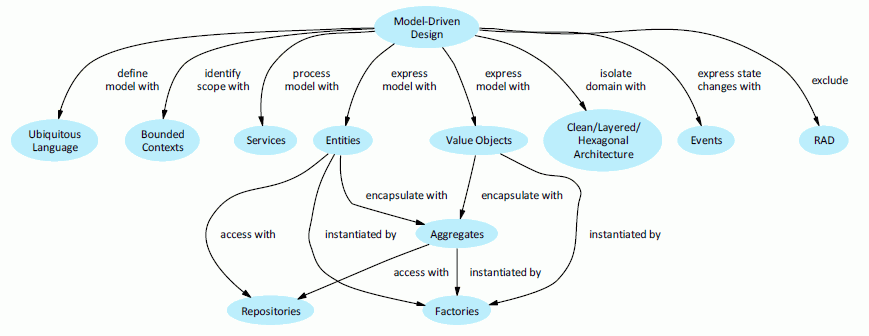
Domain-Driven Design: part 3

One year ago, we already made a quick presentation of Domain-Driven Design, in the context of our mORMot framework.
After one year of real-world application of those patterns, it is now time to give more light to DDD.

Let's continue with part 3, which will define Domain-Driven Design patterns and principles - this will be the main article of the whole serie!

Continue reading

Domain-Driven Design: part 2

One year ago, we already made a quick presentation of Domain-Driven Design, in the context of our mORMot framework.
After one year of real-world application of those patterns, it is now time to give more light to DDD.

Let's continue with part 2, which will define Domain-Driven Design high-level model principles.

Continue reading

Domain-Driven Design: part 1

One year ago, we already made a quick presentation of Domain-Driven Design, in the context of our mORMot framework.
After one year of real-world application of those patterns, and a training made by a great French software designer named Jérémie Grodziski, it is now time to give more light to DDD.

Let's start with part 1, which will be a general introduction to Domain-Driven Design, trying to state how it may be interesting (or not) for your projects.

Continue reading

2013-12-10

JSON record serialization

In Delphi, the record has some nice advantages:

  • record are value objects, i.e. accessed by value, not by reference - this can be very convenient, e.g. when defining a Domain-Driven Design
  • record can contain any other record or dynamic array, so are very convenient to work with (no need to define sub-classes or lists); 
  • record variables can be allocated on stack, so won't solicit the global heap; 
  • record instances automatically freed by the compiler when they come out of scope, so you won't need to write any try..finally Free; end block.

Serialization of record values are therefore a must-have for a framework like mORMot.

In recent commits, this JSON serialization of record has been enhanced.
In particular, we introduced JSON serialization via a new text-based record definition.

Continue reading

- page 24 of 53 -